
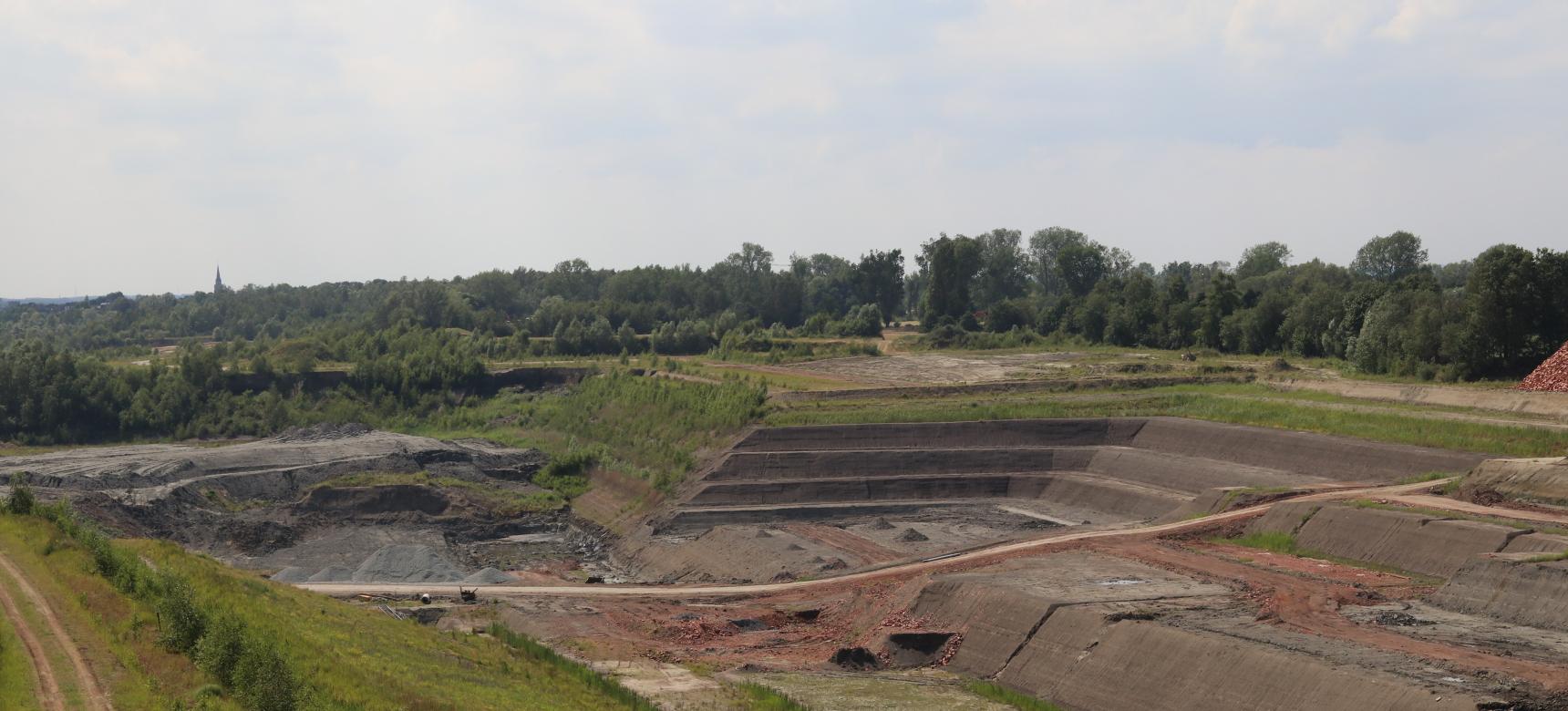
Mining clay
For a long time, most of the activities at a brickyard were done by human power. Until the 20th century, the clay was manually laid. This was done in winter when it was cold, because warmer times were used for shaping and drying the bricks. Only when there was a danger of running out of clay, clay was also laid in the summer.
In order to reach the clay, a layer of topsoil and then a layer of sand from 2 to 5 meters thick had to be dug away. Then, with small spades, a 10 by 5 cm cut of clay was dug out and tipped down. There the clay was mixed with the sulfur and water to obtain a smooth paste for the hand-molded stone. By spring, the rotted clay was transported to the brick maker.
The arrival of dredgers meant the automation of clay mining. The person who still performed manual labor on the clay front was the boulder-breaker. He had to remove the hard chalky loaves from the clay layer to prevent damage to the dredge.
With the advent of the machine brick, mixing with sulfur and rotting in the clay pit was no longer necessary. All post-processing was done by machine and in the factory.
Transport within the brickyard
The ever-expanding reclamation front made the distance between the clay quarry and the brickyard ever longer. A lot of transport was therefore needed within a brickyard.
For hand-formed bricks, there was first transportation from the clay quarry to the place where the clay was to rot. This was done by wheelbarrow along a " klootweg"; a path of wooden planks. Afterwards, the clay was transported either by wheelbarrow or by horse and "slijkwagon" to the brickmaking site. Wheelbarrows or stone wagons on a track then took the shaped bricks to the drying shed, the dried brick to the kilns and the baked brick to the unloading quay. From there, the stones then left for consumers either by ship or truck.
Clay for machine bricks was transported directly to the machine hall. This was done initially with wagons on a track and later, as still today, with a conveyor belt. With fully automated production, further transport to drying rooms and drying tunnels was also automated.
Certainly in the "handgeleeg" the wheelbarrow was very important. For each activity you had a different type. Horses were also used for a long time. A brickyard had its own stables. The use of tracks followed very quickly after the development of the railroad network. The first wagons were pushed by hand, later pulled by a horse and from the 1930s by a locomotive.